![]() |
| Water is an important resource for wine production |
Category Archives: Wine Experiences
Expressions of interest (Cote des Nuits, France – Day Two)
Filed under Winery Visits
Chalk and cheese (Cote des Nuits, France – Day One)
![]() |
| They use these at Louis Jadot to indicate when they have tasted from a barrel and it needs topping up |
Filed under Winery Visits
Keep it simple (Chablis, France – Day Two)
If anyone has played competitive team sport in their life they may have heard of the KIS principle, which stand for Keep It Simple. Looking back on my trip I am finding it fascinating that many of the wineries and regions that I most connected with have this same principle in mind. Even more interesting is that this connection was regardless of red or white wine, but applied to philosophies and practices as well as style. The clarity purity and minerality of the rieslings I tasted in Germany blew me away, as did the gruner veltliners in Austria. Some of the best wines I tasted in Spain were those that were straightforward and approachable, such as the albarinos in Rias Baixas and the verdejos in Rueda. In terms of French wine, the simple white wines of the Loire Valley and Chablis have a special place in my heart, as the minimal intervention they make in the wineries means it is purely the expression of the variety in their particular terroir. In fact there are a number of similarities in terms of climate and soil composition between Sancerre, Pouilly and Chablis, but the latter chooses to express through chardonnay rather than sauvignon blanc. The minerality of these regions is legendary, but I am starting to see there are some different expressions that still follow the KIS principle.
![]() |
| Some of the characters of Chablis |
Filed under Winery Visits
The name game (Chablis, France – Day One)
When I was younger I didn’t like my name. In terms of my first name I didn’t really have a problem with James, but I didn’t like it being such a common name, nor did I like derivations and colloquialisms of it, like Jim, Jimmy or Jamie. Considering how uncommon my surname is and how much of an individual I attempted to be, you would think I would like my surname but this was not the case. I wasn’t a fan of the length of it nor did I like the fact that people could neither spell it by ear nor could they pronounce it when reading it. I love my name now, being proud of its uniqueness and also as the last male Scarcebrook in the family I have a sense of obligation to continue the name. People in Europe, particularly France, are similarly fiercely proud of their names, often naming their children after themselves. Continuing the family name carries over to the family business as well, but complications arise with splitting of estates between children or establishing new estates with the same name. Within the same village it is not uncommon to find several producers of the same name, and within an entire region this could multiply significantly. Not for the first time on my trip I arrived at the wrong winery because it had essentially the same name, even though there is no relation between them. This gets complicated out in the market as a producer’s name is effectively their brand, so when someone else is using the same brand their products can reflect on your own reputation. I guess this is another complication that makes wine so special, and it is important to trust your source, be it a restaurant, store or importer.
![]() |
| Limestone clay and a bit of chalk |
Filed under Winery Visits
It is and it isn’t (Pouilly, France – Day Two)
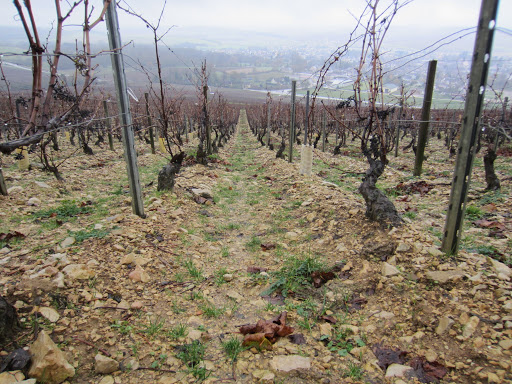
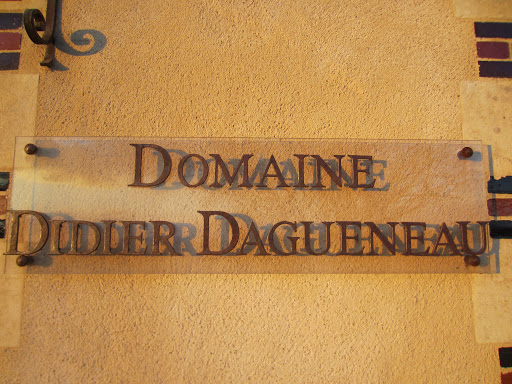
I’ve never really understood the phrase “the exception that proves the rule”, and I’m wondering if someone can explain it to me. Doesn’t an exception by definition DISprove a rule? Isn’t that the whole point of a rule? I understand the concept of “rules were meant to be broken”, never more appropriate than when talking about the rules and regulations around appellation des origine controlee (AOC) in France, and similar denominations in other European countries. The idea that the best wines are produced from certain varieties in certain terroirs perfected over the centuries isn’t the question for me. The question is the determination of yields and practices in the vineyards in cellars that are determined by this quite rigid system. In terms of planting other varieties, not only can you not label any wine made from the varieties, but the mere existence of them is forbidden. Around Europe there are mavericks looking to shake things up a bit, breaking away from the norm and attempting to disprove the rules, or prove the exception. One of these is Domaine Didier Dagueneau.
![]() |
| Domaine Didier Dagueneau |
Filed under Winery Visits
Everybody needs good neighbours (Pouilly, France – Day One)
![]() |
| Chateau de Nozet, the unofficial heart of Pouilly-Fume |
Filed under Winery Visits
Finishing big (Sancerre, France – Day Three)
It is important to remember that everything is relative, and also that there are numerous implications depending on the person and the word. Language is complicated as much as communication itself, and over the past 14 months (to the day in fact) I have had so many situations where things can have different meanings depending on audience and context. My understanding of things, not only about wine, has changed significantly and I have discovered that it is important to always clarify and speak relatively. For example, there is a word in French that will be familiar to most wine-lovers that actually has different meanings in English which are related but have different connotations. The word is ‘grand’, and in the context of vineyard classification for such regions as Burgundy and Alsace, it means ‘great’ or essentially ‘the best’. The word can also mean ‘big’ or ‘large’, which implies size rather than importance and in terms of wine, could refer to the size of vineyards or a winery for example. When a winery produces 3.5 million bottles per year in Sancerre, this is both great and large, but in the Australian context it is merely a medium-sized winery. Everything is relative. What is interesting is that in my humble opinion I began my week with the most important producer in Sancerre and finished with the largest, and the quality of the wines to decline with each estate I visited.
![]() |
| Cellars in Sancerre |
Filed under Winery Visits
All things bright and beautiful (Sancerre, France – Day Two)
![]() |
| Always work to be done in the vineyards |
Filed under Winery Visits
Personality plus (Sancerre, France – Day One)
![]() |
| The Sancerre Centre |
Filed under Winery Visits
Moullieux out (Vouvray, France – Day Two)
![]() |
| The cellars of Bernard Fouquet |
Filed under Winery Visits