![]() |
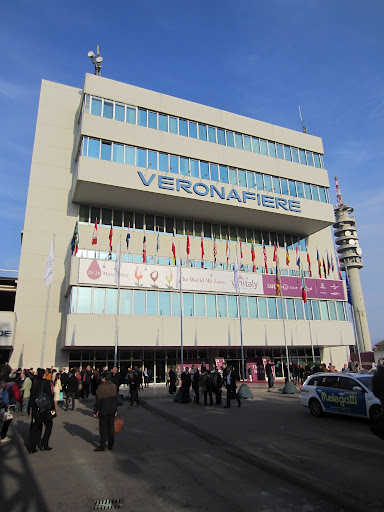
| Verona Fiere – where the magic of Vinitaly happens |
Category Archives: Wine Experiences
Vinitaly 2012
Filed under Wine Events
Pitstop (Valpolicella, Italy – Day Two)
Wandering around Verona for a day, I truly felt like I had arrived to Italy, and also I had walked onto a living breathing Shakespeare set. The city is beautiful, and has all the elements of a classic Italian city; Roman ruins, cobbled (pedestrian) streets, piazzas, trattorias, fashion stores, and lots of stylish attractive people. The city was full of people, partly taking advantage of the great weather, but also a combination of tourists and visitors for the Vintitaly fair which started on the Sunday. The fair itself is away from the centre of town, and so doesn’t interfere with daily life in Verona too much. But I’ll talk more about Vinitaly in a separate post.
![]() |
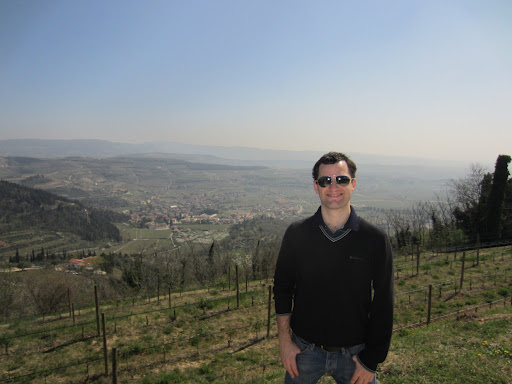
| Me above Valpolicella |
Filed under Winery Visits
This Is ITALIA!! (Valpolicella, Italy – Day One)
![]() |
| Valpolicella Rosso = pergola trellising |
Filed under Winery Visits
The sun’ll come out, tomorrow (Alto Adige, Italy – Day Three)
Thanks to the generosity of Franz Haas who put me up for the night in Ora, I didn’t have as far to travel both to and from my accommodation. Sleeping in a bit was blessed relief, as was the necessity to spend so much time in the car. Whilst it is nice to have a private room, a large bed, my own bathroom and general peace and quiet, it does get very lonely of an evening. It’s bad enough that I spend so much time in the car by myself, particularly on those long drives between regions. Travelling in Europe so far has been more difficult, as when I have been able to find hostels to stay at in the regions, they have been either empty, full of families/school groups, or the young people staying there are working or studying and not interested in socialising. The weekend I had in Vienna was fantastic, and staying with friends in Paris and Dusseldorf were great. This is one of the reasons I am so glad to be in Italy, because people seem so much more generous and hospitable and I am looking forward to sharing great times and meeting people here over the next eight weeks.
![]() |
| Protected viticulture in Terlan |
Filed under Winery Visits
Italian generosity (Alto Adige, Italy – Day Two)
For I think the first day since I arrived in Europe, today I was able to go outside not wearing my jacket, as the weather was sunny and warm(ish). Alto Adige actually gets over 300 days of sunshine each year, which not helps for the ripening of the grapes, but also gives everyone here a sunny outlook. One of my hosts on the previous day actually asked me if I had brought the rain and fog with me from Germany. Part and parcel of this sunny outlook is their love of simple pleasures, such as good food and wine. On my first two days in the region, two wineries gave me lunch, and another offered to put me up for a night nearby. When you have been travelling for six months with another 10 to go, watching money steadily drain out of your accounts, these simple gestures have the biggest resonance. It also puts me in a really positive mood, and lets me overlook any difficulties I may be having with my travel. The great news is that I have some work organised in Germany and my visa is not far away, the problem is that I have to return to Germany to collect it in person. Ce la vie!
![]() |
| My first prosciutto crudo in Italy |
Filed under Winery Visits
I say tomato, you say potato (Alto Adige, Italy – Day One)
Well I’ve finally made it to Italy, but as anyone who has crossed the border from Austria would know, it doesn’t quite feel like Italy yet. Alto Adige is also known as Sudtirol or South Tyrol. This is because for centuries the whole area was part of the Austro-Hungarian Empire up until the end of WWI. After this point the Italian border was set at the Brenner Pass on the Southern side of the Alps, but the citizens remained proudly Tyrolean. Hence they continued to speak German (albeit an Austrian dialect), ate Austrian food, and made many wines from German/Austrian varieties such as pinot bianco/weissburgunder, pinot grigio/grauburgunder, gewurtztraminer and muller-thurgau. During the fascist era Mussolini attempted to make Alto Adige an Italian speaking region like the rest of the country, by introducing southerners into the area. But the inhabitants are stubborn and proud, and now there is a mix of Italian and German spoken, almost on opposite sides of the narrow valley that makes its way south towards Trentino.
![]() |
| Pergola trellising at Tiefenbrunner; now I’m south of the Alps |
Filed under Winery Visits
Not enough time (Niederosterreich, Austria – Day Four)
It is difficult enough trying to find time to visit each region and spend enough of it to really get to know the producers, varieties and styles. There are so many regions in Europe alone that I am having to compromise in missing so that I can spend enough time in other regions. Further difficulties have come up recently as I have been attempting to get a working-holiday visa for Germany so that I can join such producers as Reichsgraf von Kesselstatt in the Mosel and Gunderloch in the Rheinhessen. It’s also important for me to be able to travel in Europe for the remainder of the year. This has meant I have had to return to my local Aliens Authority office in Neuss where a friend lives three times, the most recent time driving back for nine hours to provide fingerprints and my signature. I’m also not so happy with my car so I’m trying to find a mechanic who can have a look at it, but it’s not so easy. Thus I had to cut my Austrian journey short and I didn’t get to visit Burgenland as I planned.
![]() |
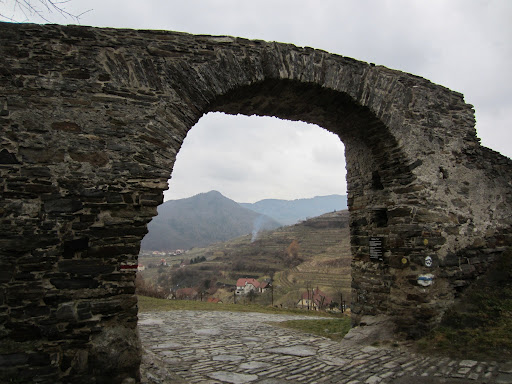
| The “Rotes Tor” (Red Door) entrance to the vineyards above Hirtzberger |
Filed under Winery Visits
Persons of interest (Niederosterreich, Austria – Day Three)
There is something quite magical about Vienna. Not only is it a beautiful and historic city but it is also a thriving metropolis, home to 2. 4 million people. Walking around the central part of the city there are any number of tourist sites; the cathedral, the Belvedere Palace, the numerous museums and theatres. You would hardly believe there are operating vineyards and wineries within Vienna, which unfortunately I didn’t have a chance to visit. By all accounts they are very traditional, making field blend wines from any number of native varieties. Vienna is a very multicultural city, which is not hard to understand when you consider that it is the gateway to the East. Something I found very interesting was the high concentration of Japanese restaurants in the city centre, even more than in Dusseldorf which has the highest concentration of Japanese people in Europe. Vienna is famous for its music, as celebrated composers like Mozart and Strauss lived here. For as little as €3 you can see one of the daily performances at the historic Opera House. Having been to a number of performances of Opera Australia back in Melbourne, one of the things I wanted to do was to see some opera in Europe, and I was thrilled to enjoy Verdi’s “Simon Boccanegra” over the weekend before returning to Niederosterreich to visit some more wineries.
![]() |
| Ruins above Weingut Nigl in Kremstal |
Filed under Winery Visits
History in the making (Niederosterreich, Austria – Day Two)
Niederosterreich is Austria’s largest and most important wine-producing area, covering just over 27,000 hectares of vineyards across eight distinct regions from the Wachau until Carnuntum. The majority of the premium wine comes from three of these regions along the Danube River; Wachau, Kremstal and Kamptal, with the top wines being made from fruit grown on steep and terraced vineyards. There are over 4,000 different producers in Niederosterreich, but the average vineyard owner only holds a few hectares of vines. The largest producers are often cooperatives or wineries owned by the state, and many of these produce large volume wines for the Austrian market. The wine consumer in Austria is very patriotic, consuming 80% of domestic production at a level of 30 L per capita per year. Austrians actually consume as much as they produce, so the 20% of production that is exported is replaced by imported wine, mostly German.
![]() |
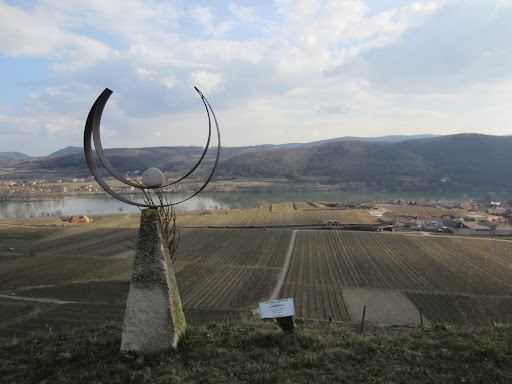
| Modern art along terraced vineyards above Unterloiben |
Filed under Winery Visits
Gruner pastures (Niederosterreich, Austria – Day One)
Although it’s nowhere near as luxurious as some of the rental cars I’ve been driving on my trip so far, it is so nice to have my own car and not worry about the daily costs involved. The 1995 Volkswagon Golf I bought for €500 was in reasonable condition but through a friend I had someone take a look and replace a few things. Otherwise it wouldn’t have even survived the eight-hour drive down to Wachau, let alone all around Europe this year. It is also great being in another new country, far away from the previous place so that the scenery looks very different. I will say that the Niederosterreich region on the banks of the Danube River reminds me a little bit of the Rheingau region of Germany, but the people and most importantly the wines are quite different. About a third of the vineyards are planted on flatter slopes, and the rest is planted on the steeper terraced slopes where you find the better parcels on primary rock with less loam. There are two major varieties; riesling and gruner veltliner, and I am here to find out more about them.
![]() |
| Domäne Wachau in Durnstein |
Filed under Winery Visits