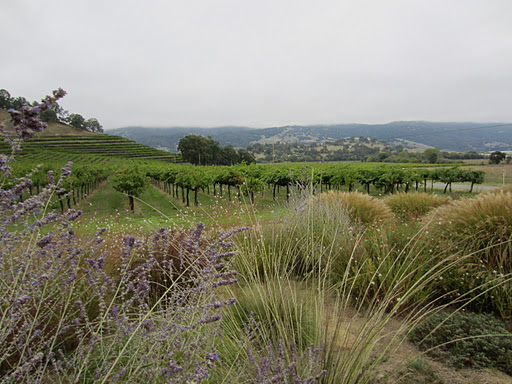
It’s safe to say that wine regions in the USA, much like in Australia, are big. This makes it difficult to categorise a region as having a certain style or characteristic. This is partly because there are differences in approaches to winemaking, but mostly because there are countless micro-climates and differences in appelation and site within a broad region. The size of the region also means you are covering a large distance when you are visiting, and getting from one appointment to another in time can have complications.
Tag Archives: United States of America
Come on down to pinot town (Willamette Valley, Oregon – Day One)
I think that Alexander Payne and Jim Taylor richly deserved the Academy Award for best adapted screenplay for Sideways. Having finished Rex Pickett’s sequel to the novel Sideways, and seeing how poor not only his prose is, but also his proof-reading, I can only imagine how badly written his first book must have been. It’s been interesting to discover what happens to the characters, and it might make an interesting film sequel. It has also proved interesting to read it as I have travelled up the west coast, following almost the same route as Miles and Jack. I have now arrived at the zenith of the novel, and the primary wine region the characters reside in. That region is the Central Otago equivalent of North America; the Willamette Valley. Steve Naughton from Pinot NOW had given me a detailed list of wineries to visit, and over the past few weeks I had contacted most of them, and most had got back to me. Much like the rest of my trip up the coast so far, my timing was a little off as vintage was fast approaching and the much smaller wineries in the Willamette Valley were tentative to set anything up until closer to the date. They were very positive about me visiting, which was a lot more than I had gotten out of some Californian regions.
Filed under Winery Visits
Oh, the scenery! (Rogue Valley & Eugene, Oregon)
What a change, to drive from Ukiah in Northern California into Southern Oregon. Once you get past Redding, California the scenery becomes a lot more dramatic. You start to see a lot denser pine forests and heading up into more mountainous climbs. The highway becomes steeper and more curvy, and before long you see the snow-covered Mount Shasta approaching. And not long after that, you are in Oregon, without any fanfare at all. It’s a pretty long drive from Ukiah to Eugene, so I broke it up by stopping in Medford at the heart of the Rogue Valley.
I called into the second largest winery in the region, named Roxy Ann Winery. Historically the estate was covered in orchards, but was converted to wine grapes just over ten years ago. They are best known for their pinot gris of which they make quite a bit, but I thought the standout in terms of value was the Honour Barn Red. I got the chance to try their pear wine, which was very dangerously easy to drink. The other winery I dropped in on was Del Rio, the largest in the region. Unfortunately owing to the fact I didn’t have a business card “proving” that I worked in the wine industry (something I have since remedied thanks to Staples’ four hour turnaround) I could only try one wine. Both wineries had a Claret, a term that apparently can be used as long as it was before the watershed imposed by the EU.
![]() |
| RoxyAnn tasting room |
Filed under Winery Visits
California – what I’ve learnt
Wines born of sunshine and heat are fruit driven and higher in alcohol. They tend to be richer and fuller in fruit, particularly the chardonnays and Bordeaux varieties. This does not mean they are simple wines, as in most cases they have a higher acidity to balance out the fruit and alcohol. Winemaking techniques are fairly universal. They don’t do anything different in the winery or out in the vineyards that distinguishes them in particular. What speaks volumes is the quality of the fruit and the expressions of terroir. The problem is when winemakers do too much to interfere with the fruit, attempting to exert their influence on the finished product.
Filed under Articles
Alsace or Burgundy, you be the judge (Anderson Valley, California)
The Anderson Valley suffers somewhat from isolation, as every road into it is very windy and narrow (which makes for great driving, actually). There isn’t a large population living there either, so drawing people in is very important. Luckily they are blessed with some of the best fruit in California, both wine grapes and table fruit like apples. Post-Prohibition this region was established until the early ’70s and so they are younger than most regions in the state. The key varieties here are pinot noir (the best in California in my opinion), and gewürztraminer.
![]() |
| Tasting at Goldeneye Winery |
Filed under Winery Visits
Honesty is the best policy (Mendocino & Lake Counties, California)
First of all, Mendocino and Lake Counties are both beautiful. Secondly, some of the best wines I have tried came from fruit grown in Mendocino County. The major problem with Mendocino and Lake compared to other regions, is its remoteness (2.5 hours from San Francisco instead of 1 hour for Napa and Sonoma), and it’s size. These aren’t problems that I have personally, it was actually nice to be visiting wineries where I was the only one there. They are problems with wine tourism though, and the area needs to draw more people up from the Bay area to have them try to buy the wines. So if you ever come to California, I highly recommend making the trip up North, beautiful scenery, people and wines.
![]() |
| Saracina vineyards |
Filed under Winery Visits
Sirah that aint Petite (Dry Creek & Alexander Valleys, California)
My second day in Sonoma County had me heading further North into the Dry Creek Valley. As the name suggests the climate is a lot drier and warmer with quite cool nights. If I were to compare it to a region in Australia, it would be similar to Bendigo. The two most important varieties here are zinfandel, that classic California grape, and petite sirah. It wasn’t until I came to Dry Creek that I was reminded that petite sirah is another name for durif, the famous Rutherglen grape. This made a lot of sense and of course I felt a bit silly for forgetting.
![]() |
| Breakfast of champions |
Filed under Winery Visits
This is more like it (Chalk Hill & Russian River Valley, California)
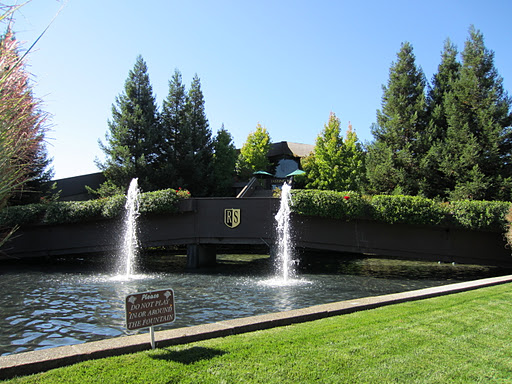
Driving up through the Sonoma Valley towards Santa Rosa, it was good to be out of the Napa Valley. Not that it wasn’t nice, it’s just wall to wall vines and a winery every 250m. Being out in Carneros and Sonoma Valley was a return to terroir, with actual site selection for planting and smaller, more understated wineries and tasting rooms. It isn’t until you continue North into Sonoma County you realise how beautiful this part of California is, and although it is as busy as Napa from a tourism perspective, the roads aren’t chock-a-block with cars as the region is more spread out, with larger sub-regions. The sub-regions of Sonoma are the Russian River Valley (home of pinot noir and chardonnay), Dry Creek Valley (home of zinfandel and petite sirah), and Chalk Hill and Alexander Valley (home of everything else).
![]() |
| Rodney Strong Vineyards |
Filed under Winery Visits
The other Napa (Los Carneros, California)
Although still part of the Napa AVA, Los Carneros is a very different beast. It is closer to San Pablo Bay so has more coastal breezes, and the fog is pushed into the Napa Valley from here. So although it is a lot cooler, there are more sunshine hours for a much more even ripening. There are two major varieties here, pinot noir and chardonnay. Countless wineries in the Napa Valley source fruit of these varieties. In fact every chardonnay I tried came from Carneros. The region feeds into the Sonoma Valley, and thus Carneros actually has feet in both Napa and Sonoma County. Hyde de Villaine is a partnership between Larry Hyde who planted his famous vineyard back in 1979 in Carneros, and Aubert de Villaine who married Larry’s first cousin Pamela, and is the winemaker at Domaine de la Romanee Conti. Their goal is to find a truly iconic and unique expression of California, and the winemaker since 2002, Stephane Vivier, is succeeding at this in spades. The winery itself is located in Napa town, but the vineyard is in Carneros. It is difficult not to compare the wines to their French counterparts, but in style they reflect their origins significantly.
![]() |
| HdV Vineyards tasting |
Filed under Winery Visits
These guys know wine tourism (Napa Valley, California – Day Three)
My final day in the Napa Valley started with a visit to Shafer Vineyards back in the Stags Leap District. Shafer dates back to 1972, around the same time that Stag’s Leap Wine Cellars were established and before the Napa Boom post-1976 Paris Tasting. You most definitely can’t say that John Shafer was jumping on the bandwagon. He left a career in the textbook publishing industry to establish a vineyard to grow grapes, and took his time to re-establish the site before producing his first vintage in 1978. From the beginning the wines gained much attention, and they have been producing their flagship Cabernet from the same vineyard for over 25 years.
![]() |
| Shafer winery |
Filed under Winery Visits