Tag Archives: Germany

Due south (Rheinhessen, Germany)

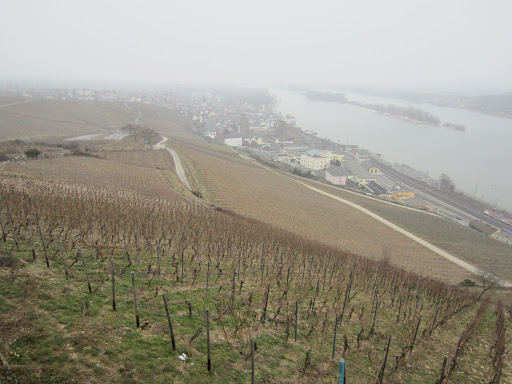
As mentioned in a previous post, the Rhineland-Pfalz region has a lot of regions that are all a stones throw away from each other. This means that even though I had already been through the Rheinhessen region on my way to the Rheingau, it isn’t difficult to backtrack a little. Thus I was able to visit a few wineries here after all, who were kind enough to make some time for me at such short notice. The Rheinhessen is the largest viticultural area in Germany, stretching from the Nahe in the west to the Rhine in the east, from Worms in the south to Bingen in the north. In an area of roughly 26,000 hectares of land, you are undoubtedly going to get some variation in soil type, exposition and climate. Thus I was glad to visit two wineries at each end of the region, to see if the difference was discernible.
Vineyard in the Northern Rheinhessen

Continue reading

Leave a comment

Filed under Winery Visits

Does size count? (Rheingau, Germany – Day Three)

One of the greatest things about German white wines is the high levels of acidity that keep them fresh and make them live for so long in the bottle, also make them food-friendly and mouth-watering. The result is they make you hungry like an aperitif should. In the current climate, you naturally want robust hearty food that warms you up, such as bratwurst, wiener schnitzel and sauerbraten. Thus any of the weight I lost in France three weeks ago, I have subsequently put back on as my appetite has gotten bigger and I have been eating more protein and carbohydrates. This is why German Riesling and Asian food is so great together, as everything tends to be fresher and lighter. Not to mention the higher sugar levels and lower alcohols really keep the spice in check.

Robert Weil estate

Continue reading

Leave a comment

Filed under Winery Visits

Weathering the storm (Rheingau, Germany – Day Two)

The previous evening it snowed in the Rheingau, so in the morning I got to see parts of the region under a beautiful blanket of white. It is amazing when you consider not only how small the Rheingau region is, but also how close you are to several other regions. For fun I put some of the other wineries I plan on visiting in other regions when I was in Rudesheim on the previous day. Amazingly, a winery in the Pfalz which is virtually two regions away, was still less than an hours drive. It really shows how such a small area can have such a big difference on a wine, particularly if it is made from the same variety. The Rheingau sits on the northern bank of the Rhine, the Nahe region on the eastern side of the Nahe River, and the Rheinhessen sits on the western side of the Nahe between the Rhine.

Commemoration statue at Schloss Johannisberg

Continue reading

Leave a comment

Filed under Winery Visits

Let it snow (Rheingau, Germany – Day One)

The past week in Germany has highlighted that classic adage that timing is everything. As mentioned in my last post, due to the confluence of the time of year (post-Christmas, mid-Winter), estates being small and very busy (bottling, in Australia for the Frankland Estate International Riesling Tasting) and the short notice I was giving many estates, I wasn’t able to secure any appointments in the Rheinhessen. So it was with some regret that I move onto the Rheingau, again hoping that I will be able to meet with some producers at Prowein.The drive up the Rhine towards Mainz was quite lovely, and the clear days improve the extreme cold temperatures. The Rhine River itself is the largest in Germany, and the influence it has is quite profound, as the large body of water has a mitigating influence on temperature oscillations between day and night. In such extreme conditions as the Rheinland-Pfalz region of Germany where it can get very cold at night, this is essential for slow even ripening of the fruit. In conjunction with this it is important to find sites that have good steep exposition to the sun, which shines from the South in Europe. The Rheingau region is warmer than many of its neighbours, and thus achieving ripeness isn’t as difficult as it is in the Mosel. The climate also means that vintners can work with other varieties such as spatburgunder, grauburgunder and weissburgunder, as well as the noble Riesling variety. The region stretches for less than 50 km between Wiesbaden and Lorch, and includes vineyards on the Main River.

Vineyards above Rudesheim

Leave a comment

Filed under Winery Visits

Breaking the ice (The Nahe, Germany)

Well I guess it’s just my luck that I am in Germany during a severe cold snap in Europe. This has it’s complications, such as roads being closed so having to circumvent and using a little extra fuel to heat up the car. But I guess I wanted to experience extremes, and this is certainly that. Driving the short distance from the Mosel to the Nahe was beautiful, as the past few days have been lovely and clear. The Nahe itself is a lot more rolling than the jaggedness of the Mosel, and certainly less steep. The river itself is a lot smaller, and as such there were many places that it had frozen over. I was pretty excited to see this, never having seen a frozen river before. There seems to be more variation in the soils from just slate, having quartz and some alluvial stones as well. Due to the timing of year, the unfortunate short notice I gave to some wineries, and the much smaller size of wineries here, I was only able to make it to one appointment in the Nahe for this two-day trip, but now that I have some tickets to Prowein in Dusseldorf in a month, I can catch up with some more producers there.

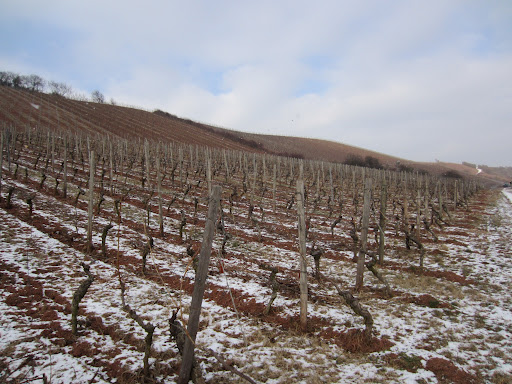
Vineyards above Oberhausen an der Nahe

Continue reading

Leave a comment

Filed under Winery Visits

An Education (Mosel, Germany – Day Four)

Tasting the wines from the Mosel, I started to come up with a theory as to why they are so unappreciated in so many markets. Consumers are led to believe that wine must be strong and possibly heavy, and if it a wine is easy to drink then it is simple and cheap. The nature of wines from the Mosel having residual sugar to offset the acids makes them very fresh, approachable and easy to drink. Therefore in their minds they almost feel guilty that they are so easy to drink. It also comes back to the idea that wine is an alcoholic beverage consumed to become intoxicated, rather than how it should be consumed, with food. Being so approachable and low in alcohol makes these wines so adaptable to food it begs the question; what does it take to get people to drink these wines more, and value them properly?

Leave a comment

Filed under Winery Visits

The definition of austerity (Mosel, Germany – Day Three)

I shared an interesting discussion with Daniel Vollenweider over the nature of the riesling grape on my second day in the Mosel region. Previously he had spent time working in wineries in New Zealand and the United States, and he couldn’t understand why the New World considered riesling an aromatic variety. Tasting many of the wines from the Mosel and seeing how complex they can be, it isn’t hard to understand his point. But an investigation on Wikipedia classifies the variety as aromatic, and in other regions such as Alsace they may classify it as such too.What then is an aromatic variety. The literal interpretation would be that it has more bouquet than a complex wine, but this isn’t necessarily the case. It is perhaps more pertinent to consider the nature of the winemaking, whereby it is generally fermented in stainless steel tanks, and sees no barrel maturation. The complexity comes in the variety itself, the environment (such as the minerals in the soil), and from bottle age. So in this sense riesling could be considered complex, much like chardonnay (complex variety) from the Chablis region. I guess the difference with riesling wines from the New World is that they are almost always consumed young. This would make them aromatic in nature, as they have little inherent complexity, compared to wines from the Mosel. What are your thoughts on the topic?

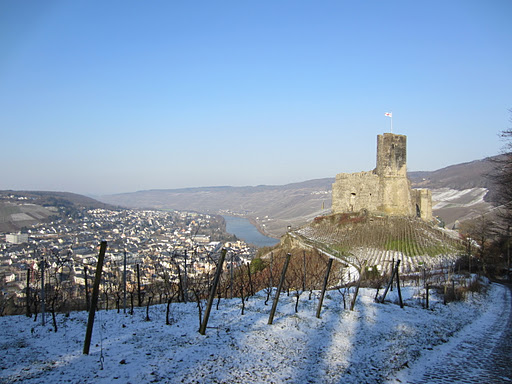
Castle Landshut above Bernkastel

Continue reading

Leave a comment

Filed under Winery Visits

Back to the future (Mosel, Germany – Day Two)

For the first time on my trip, I feel totally out of my depth in the Mosel Valley. Having started my wine career in the Yarra Valley, and working for a sparkling producer, means that I am very familiar with the varieties of Burgundy, Bordeaux and the Rhone Valley. When it comes to Riesling, I am a little bit out of my element. I have gained some familiarity with the wines of such regions as the Clare Valley and Eden Valley, and also other emerging regions in Australia and New Zealand. Visiting Alsace in 2010 helped a lot, but of course Riesling isn’t necessarily the focus. German rieslings, particularly the wines of the Mosel, are in an entirely different league. This is of course why I have come to the region; to gain familiarity and experience.

On top of the world, looking down on creation!

Continue reading

2 Comments

Filed under Winery Visits

Take me to the river (Mosel Valley, Germany – Day One)

Whilst I admit that it was wonderful starting the European leg of my trip in the familiarity of Champagne, there was something quite exhilarating about arriving into a totally new region. I spent the past week staying with a friend in the German town of Neuss trying to organise my visa and a car, and then caught up with some friends I met in the States in Cologne over the weekend. On Sunday afternoon I drove down in very cold conditions towards my base for the next five nights, the town of Traben-Trarbach, situated in the middle of the Mosel-Saar-Ruwer. The town straddles the Mosel River; Traben on the North side and Trarbach on the South. Just as I was entering the valley above the Mosel River, it began to snow very lightly, which made it that much more beautiful. It was already dusk so it was a little too dark, but amazing nonetheless.

Continue reading

Leave a comment

Filed under Winery Visits