![]() |
| Saint Joseph vineyards |
Tag Archives: France
Rising cream (Rhone Valley, France – Day Four)
Filed under Winery Visits
Only a Northern Song (Rhone Valley, France – Day Five)
You can’t imagine how good it felt to return to Lyon, which is still by far my favourite city in France, having made it part of my trip in 2010. I actually spent July 14th (Bastille Day outside of France) in Lyon with a friend, and had enjoyed the fireworks display that launches from the Basilique on top of the hill above old town. Lyon is the third most populated city in France, but has the second largest metropolis. It has a long history dating back to the Roman era, and since this time has always been an important point between different parts of Europe. This made it a very strong trading point, which in my opinion is the reason that arguably the best food can be found in Lyon, ask any French person. You can also find the best and most diverse French wine here, partly because of the vibrant cuisine and bar scene, but also because Lyon is located right in the middle of four of the best regions in France; Rhone Valley to the south, Loire Valley to the north-west, Burgundy to the north, and Jura to the east. Lyon has been growing a lot recently, due to increase in business activity and also many students coming to the universities, many of them international. I’m not sure why it isn’t on more tourists route in France, but I highly recommend it for history, culture and cuisine. It was here that I spend five nights in, and took day trips down into the Northern Rhone Valley, the first day of which I visited Jean-Luc Colombo in Cornas.
![]() |
| Syrah has such a beautiful leaf |
Filed under Winery Visits
Delas Freres – 24/05/2012
Saint Joseph Blanc 2011 (>95% marsanne)
Crozes-Hermitage Blanc 2010 (<90% marsanne)
Clos Bouchier Condrieu 2010 (100% viognier)
Cotes-du-Rhone Rouge 2010 (mostly syrah)
Domaines Des Grands Chemins Crozes Hermitage 2009
Saint Joseph Rouge 2009
Cornas 2009
Cote Rotie 2009
Domaine des Tourettes Hermitage 2009
![]() |
| Delas Freres red wines |
Filed under Tasting Notes
Jean-Luc Colombo – 25/05/2012
La Redonne Cotes-du-Rhone Blanc 2011
La Belle de Mai Saint Peray 2009 (80% roussanne, 20% marsanne)
Les Lauves Saint Joseph 2010
Terres Brulees Cornas 2009
Terres Brulees Cornas 2008
Les Fees Brunes Crozes-Hermitage 2009
Les Ruchets Cornas 2009
![]() |
| Jean-Luc Colombo Les Ruchets Cornas 2009 |
Filed under Tasting Notes
All things considered (Rhone Valley, France – Day Three)
The Rhone Valley is arguably one of the most diverse regions in France, if not Europe. Covering over 200 km from north to south it is one of the longest regions, and with the difference in climate and soil conditions provides many opportunities for viticulture. The region is split from Valence, about 100km north of Avignon and 100 km south of Lyon. North of Valence has a much more continental climate, cooler and well protected from winds and rain. South of Valence is more Mediterranean in climate, warmer with more wind influence. This is probably the most important difference between the north and south. Throughout the entire region, there are a multitude of producers of different size and style. Growers who may not make or bottle their own wine may be part of a cooperative that vinifies the fruit, and either sells the wine in bulk or bottle. There are more artisan producers who only produce wine from their own estates, whether in a single appellation or several. Then there are those in between, who produce wine from their own estates, and also purchase fruit and/or wine from growers to produce/bottle under their own label. It is very common for producers in the Northern Rhone Valley to operate in this model, as in the north there are not enough vineyards and they are also very expensive to purchase and manage, and so they compensate by bottling wine from the south were fruit is less expensive and in much larger supply. In several cases a Cotes-du-Rhone Rouge wine may account for 50% of the bottles sold each year. The first appointment for my third day epitomises this model (Guigal), the second has only just started to move into this realm (Chateau Font de Michelle), and the third only produces wine from their own estates across three appelations/vineyards (Domaine de la Renjarde/Le Prieure de Montezargues).
![]() |
| Only days away from capfall and flowers developing |
Filed under Winery Visits
Domaine Font de Michelle – 23/05/2012
Cotes-du-Rhone Rouge 2010 (grenache, syrah, cinsault)
Cotes-du-Ventoux Rouge 2010
Cotes-du-Rhone Village 2010 (1005 syrah)
Gigondas 2010 (95% grenache, 5% mouvedre)
CT9 Blanc 2011
CT9 Rouge 2009
CT9 Vielles Vignes 2009
CT9 2010
CT9 Vielles Vignes 2010
Filed under Tasting Notes
Guigal – 23/05/2012
Crozes-Hermitage Blanc 2010 (95% marsanne, 5% roussanne)
Condrieu 2010 (100% viognier)
Hermitage Blanc 2007 (95% marsanne, 5% roussanne)
Ex Voto Hermitage Blanc 2009 (100% new oak)
Saint Joseph 2009 (100% syrah)
Cote Rotie Brune et Blonde 2007
Hermitage 2005 (100% syrah)
Chateau d’Ampuis Cote Rotie 2007 (eight parcels)
La Turque Cote Rotie 2008 (Single vineyard, 98% syrah, 2% viognier)
Ex Voto Hermitage 2006 (100% syrah)
Filed under Tasting Notes
Are you Rhonesome, tonight? (Rhone Valley, France – Day Two)
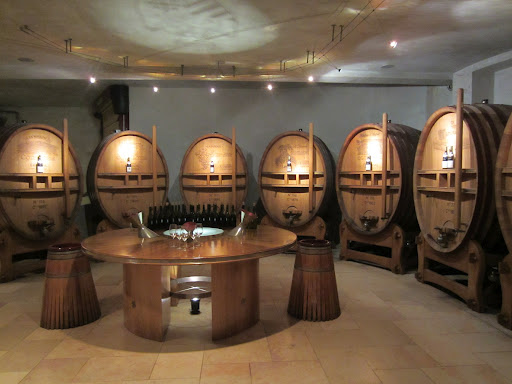
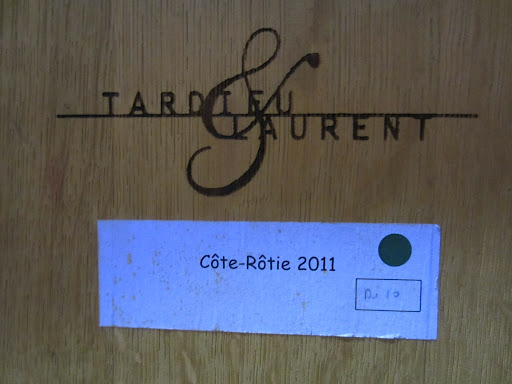
There are so many differences between the Northern and Southern Rhone Valleys that they should almost be called completely different names. Almost the only thing in common as I mentioned in my last post, is the fact that the four varieties grown in the north are also grown in the south. The Northern Rhone is a much more narrow and elevated valley than in the south, which opens up into wide plains with rolling hills rather than steep cliffs. This type of land actually reminds me of the way the Adige River flows south from Austria through the Italian Alto Adige and Trentino regions into Veneto. Secondly the amount of vineyards in the Northern Rhone is 3,000 hectares, which is the same amount as Chateauneuf-du-Pape alone, one single appellation of almost ten in the Southern Rhone. Thirdly the general approach for the Southern Rhone is for volume rather than quality, particularly for the Cotes-du-Rhone appellation, and there are only a few which go for quality above all else. In the Northern Rhone there is really only one appellation of eight that is more geared towards volume and compared to the Southern Rhone would be considered one of the quality appelations. In the Southern Rhone there is significantly more wine blended between areas than in the Northern Rhone, not to mention a great many more varieties blended, whereas in the north they really only use four and never blend more than two together. Probably the biggest difference is the amount of wine produced by cooperatives, much of which is sold to negociants within the Rhone Valley or outside of it and then bottled by someone else. Very rarely does wine get sold in bulk in the north; it is either sold as grapes or bottled wine. The first appointment I had for today was a negociant producer owning no vineyards (Tardieu-Laurent), and the other was the opposite, only producing wine from their vineyards in the Southern Rhone Valley (Vieux-Telegraphe).
![]() |
| Different sizes of barrels used to mature wine |
Filed under Winery Visits
Vieux-Telegraphe – 22/05/2012
Clos La Roquette CT9 Blanc 2011
Rich phenolic nose, floral ripe peach, apple pear and lees notes. On the palate very light, clean and balanced, some late fruit sweetness and very subtle oak texture and complexity.
Vieux-Telegraphe CT9 Blanc 2010
Concentrated reductive yet rich nose, crushed floral perfume, guava and pear, with some lees derived nutty cheese elements. Very lively yet fat and rich texture, masculine full oaky style, well-blended but very young with great ageing potential.
Les Pallieres Terrasse du Diable Gigondas 2009
Liquorice raspberry floral fruit sweet smokiness with some subtle aromas of asparagus. Concentrated dark fruits, chocolate subtlety and fruit sweetness, stalky savoury elements with some smoky flavours as well.
Les Pallieres Les Racines Gigondas 2009
More brazen in style, raisin and caramel notes, toastier and more robust aromatically. Light and clean on the palate but with more depth, darker fruit and oak sweetness, intense spice, a more serious wine.
Clos La Roquette CT9 Rouge 2009
Light in colour, fresh clean, delicate floral and fruit elements aromatically. Good integration on the palate, full-flavoured yet soft and rich, opulent red fruits with some carob notes and also fresh acidity.
Vieux-Telegraphe CT9 Rouge 2009 (65% grenache)
Intense ruby brick red colour, closed delicate red liquorice with spice, chocolate and black fruits on the nose. Quite dense, more brooding in structure and masculine in style, smooth yet dark and bold tannins.
Vieux-Telegraphe CT9 Rouge 2001
Aromatically closed at the moment, salted chocolate and caramel, subtle red currants and raisins, smoky meat and truffle complexity. Supple yet dense tannins, not particularly expressive, very subtle mature mint notes. Hard to tell if this wine is just shut down or peaking a little bit.
![]() |
| Vieux-Telegraphe wooden case |
Filed under Tasting Notes
Tardieu-Laurent – 22/05/2012
Hermitage Blanc 2010 (75% marsanne, 25% roussanne)
Cotes-du-Rhone Rouge 2010 (60% grenache, 40% syrah)
Vacqueyras 2010 (80% grenache, 20% syrah)
Gigondas Vielles Vignes 2010 (90% grenache, 5% syrah, 5% mouvedre)
Chateauneuf-du-Pape 2010 (75% grenache, 15% syrah, 10% mouvedre)
Chateauneuf-du-Pape 2010 Cuvee Special
Crozes-Hermitage 2010 (100% syrah)
Cornas 2010 (100% syrah)
Cornas Vielles Vignes 2010 (100% syrah)
Cote Rotie 2010 (100% syrah)
Hermitage 2010 (100% syrah)
Filed under Tasting Notes