The past week in Germany has highlighted that classic adage that timing is everything. As mentioned in my last post, due to the confluence of the time of year (post-Christmas, mid-Winter), estates being small and very busy (bottling, in Australia for the Frankland Estate International Riesling Tasting) and the short notice I was giving many estates, I wasn’t able to secure any appointments in the Rheinhessen. So it was with some regret that I move onto the Rheingau, again hoping that I will be able to meet with some producers at Prowein.The drive up the Rhine towards Mainz was quite lovely, and the clear days improve the extreme cold temperatures. The Rhine River itself is the largest in Germany, and the influence it has is quite profound, as the large body of water has a mitigating influence on temperature oscillations between day and night. In such extreme conditions as the Rheinland-Pfalz region of Germany where it can get very cold at night, this is essential for slow even ripening of the fruit. In conjunction with this it is important to find sites that have good steep exposition to the sun, which shines from the South in Europe. The Rheingau region is warmer than many of its neighbours, and thus achieving ripeness isn’t as difficult as it is in the Mosel. The climate also means that vintners can work with other varieties such as spatburgunder, grauburgunder and weissburgunder, as well as the noble Riesling variety. The region stretches for less than 50 km between Wiesbaden and Lorch, and includes vineyards on the Main River.
 |
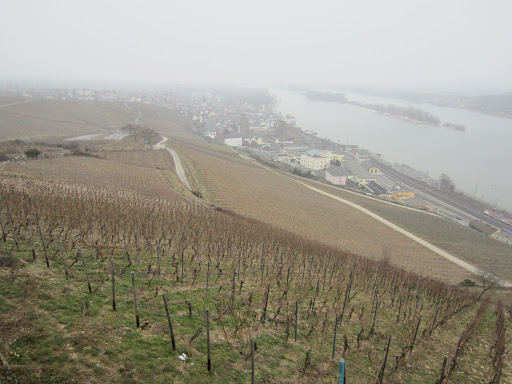
| Vineyards above Rudesheim |



 The Intrepid Wino